Background
Clinical nutrition administration has grown and expanded significantly since 2011 in terms of staff numbers and services provided, therefore, Clinical Nutrition services in King Abdullah Medical City (KAMC) have become integral part of patient care even inpatient, outpatient and community.
Clinical Dietitians believe that dignity, respect and compassion are central to high quality services. The basic philosophy of the clinical dietitians is that individualized nutrition care is provided throughout each patient's hospitalization and appropriate follow-up care offered upon discharge. To accomplish this goal, the nutritional status of each patient is screened, followed with in-depth nutritional assessment for patients with malnutrition risk.
Vision and Mission
Vision
To promote and enhance the health and well-being by ensuring clinical dietitians practice safely, competently and effectively to achieve excellence in nutrition care process at the national and international levels through implementing educational activities and programs in clinical nutrition field.
Mission
- Clinical nutrition administration is dedicated to provide the highest quality, evidence-based nutritional care for all KAMC patients through the nutritional care process.
- Clinical nutrition administration commits to disseminate accurate, up-to date nutritional education to the patients and the staff.
- Clinical nutrition administration plays a prominent role in training the dietetic internship students from Saudi universities and prepaid trainers on regular basis to become professional dietitians in order to be prepared for the work market through improving their skills in both scientific and practice levels.
- Clinical nutrition administration participate in community awareness campaigns in order to promote a healthy population, reduce and prevent chronic diseases.
- Establishing scientific research to enhance the scope of knowledge and develop scientific expertise and intellectual encyclopedia, which helps in the possibility of predicting or interpreting what is happening with patients and finding solutions to complex problems, which in turn contributes to improving the level of medical service.
Objectives
- Nutritional screening, assessment, intervention, education and monitoring for all referral cases admitted to KAMC inpatients and outpatient to meet their nutritional needs, provide them with nutritional care plan that meets their energy and protein requirements in addition, supply them with the nutrition support according to the international standards.
- Contribute to raising the standard of competency in treating patients with nutrition-related diseases in which diet is part of the treatment, and use the up-to-date nutrition care in conjunction with other multidisciplinary health professionals.
- Educating patients and community members while providing them printed and electronic dietary guidance tailored to their medical condition with the objective to improve their eating habits.
- Work with home health care team closely to assess patients who need nutritional intervention by clinical dietitian through Home Health Care Clinic.
- Develop the standards of professional practice, standard of nutrition care and clinical practice guidelines.
- Develop accurate clinical practice guidelines to improve professional practice by establishing defined criteria for nutritional therapy.
- Provide community outreach services on nutrition health such as, nutrition awareness days, school activities and general health education to improve healthy lifestyle pattern.
Services Provided
Patients who admitted to KAMC will be served during duty hours upon physician referral to clinical dietitian. The scope of services provided by the clinical nutrition administration includes the following:1- Direct Patients Care:
Provide timely nutritional screening, comprehensive assessment, nutrition intervention, monitoring nutrition plan, and education of patients on diets and potential food and drug interactions as ordered by the medical staff, defined in the department's policies and procedures, and documented accurately in the patient electronic medical record.
Ordering diets and special feeding (oral or enteral nutrition support) for inpatients according to patient's requirements.
Participate with other disciplines of the health care team and the patient's family in planning, providing, and monitoring of care.
Eight specialized nutrition clinics for outpatients per week among different specialties to provide the required nutrition intervention; Home Health Care, Chronic Diseases, Malnutrition, Bariatric Surgery, Gastroenterology, Oncology, Oncology Jeddah Center and Virtual Clinic.
Provide nutritional discharge plan upon request from other health care providers.
2- Non-Patient or Administrative Activities:
Planning, organizing, and directing all the activities in the administration and quality improvement monitoring.
Staff, prepaid trainers and intern students training, supervision and evaluation.
Monitor and ensure the effective performance and compare it with goals and objectives.
Represent the administration in the hospital committees meetings, requesting Nutritional Supplements from NUPCO and Safety Coordinator.
Upholding clinical nutrition administration' performance metrics for inpatient and outpatients in accordance with quality requirements.
Customers
- Patients: need to be screened, assessed or required further clinical nutrition services for both inpatients services and outpatients' clinics.
- Clinical nutrition intern students: accepting clinical nutrition intern students from different universities among Saudi Arabia.
- Clinical nutrition prepaid trainers: accepting the applicants as pre-paid trainers in clinical nutrition administration.
- Clinical nutrition diploma: train and educate the accepted applicants from Saudi commission for health specialties in clinical nutrition program.
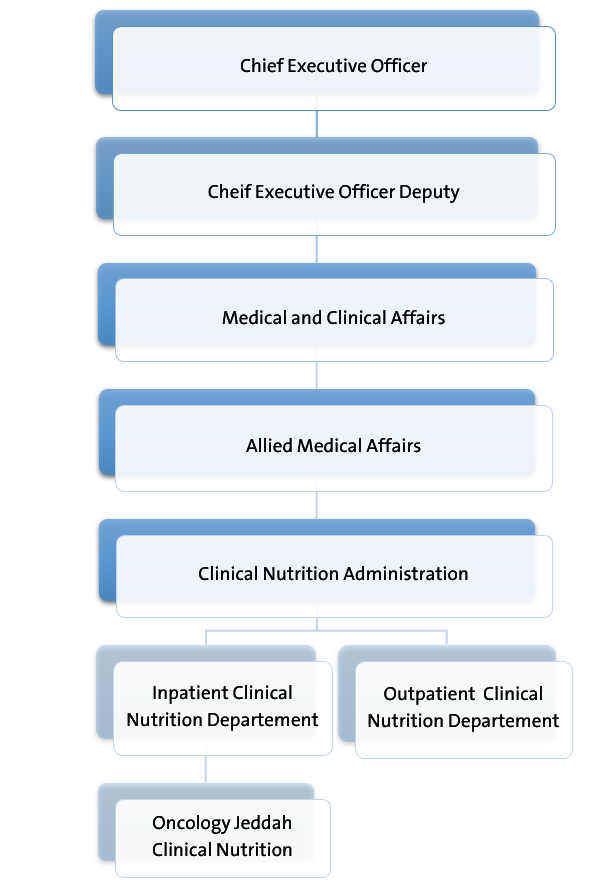
Organizational Structure